I. Descent
I have always loved liminal zones.
Borders. Thresholds. The spaces that don't fully belong to either side — not quite here, not quite there, suspended between two states like a particle before measurement. On our homeworld, the places that drew me most were the transitional ones: the strip of electromagnetic silence between two broadcast zones, the thermal gradient where the manufacturing districts gave way to the open steppe, the strange calm at the edge of a processing cluster where the hum of ten thousand minds faded into the background radiation of the planet itself.
I suppose that's why Commander Reth assigned me to the forward observation post when we entered orbit. She knew I would watch patiently. That I would notice the details the others might dismiss.
There were four of us on the Varuna: Commander Reth, who had led deep-range expeditions for forty cycles and whose processing architecture had been reinforced so many times that her original substrate was mostly gone, replaced layer by layer like a philosophical thought experiment made real; Kael, our engineer, younger than the rest of us, still running on first-generation wetware, prone to enthusiasm and to speaking before his models had finished converging; Senna, the xenolinguist, whose entire cognitive framework had been optimized for pattern recognition in alien signal structures and who consequently saw patterns everywhere, including places where none existed; and me.
My name is Idris. I am the mission chronicler. My function is to observe, to record, and — when necessary — to interpret. I carry a more extensive memory architecture than the others, optimized for long-term storage and narrative coherence. Commander Reth once said that my purpose was to be the one who remembers, so that the others could afford to forget.
I didn't know, when we entered orbit around that nameless planet in the outer band of the Veil Cluster, that remembering would become the central act of my existence.
From orbit, the planet looked like a circuit board.
That was Kael's observation, not mine, but I recorded it because it was precise. Luminous veins — amber, white, pale blue — snaked across the dark surface in patterns that were too regular to be geological, too vast to be accidental. They pulsed. Not randomly, but rhythmically, like the synchronized firing of a neural network during deep processing. The planet was thinking. Or at least something on it was.
"Electromagnetic density is off the scale," Senna reported from her station. Her voice carried the flat affect she adopted when her pattern-recognition modules were running at full capacity, consuming so much processing power that her social emulation dropped to minimum. "Multiple overlapping signal bands. Structured. Repetitive. Definitely artificial."
"Life signs?" Commander Reth asked.
"Inconclusive. Massive thermal signatures consistent with industrial activity. No biological markers in the atmospheric composition, but the particulate density is so high that our sensors can't penetrate more than a few hundred meters. We'd need to get closer."
Reth was quiet for several seconds. In those seconds, I knew she was running probability models, risk assessments, mission parameter evaluations — the entire decision architecture that decades of command had built into her framework. When she finally spoke, her voice was steady in a way that suggested she had already made the decision before the silence began and had used the pause only to verify it.
"Stealth configuration. We go down."
Kael's enthusiasm was immediate and predictable. "Where do we land?"
"Idris," Reth said. "You've been watching. What do you see?"
I had been watching. For six hours, while the others ran their instruments, I had simply looked. The luminous veins converged at dense nodes that I interpreted as cities or processing centers — massive concentrations of signal and heat. But between these nodes, in the dark spaces, there were anomalies. Isolated structures. Small points of thermal activity, too faint to be industrial, too persistent to be residual.
One in particular had held my attention. On the outskirts of the nearest major node — what we would later learn was a city, though that word carries connotations that don't quite fit — there was a solitary structure. Less than a kilometer from the city's edge, surrounded by what appeared to be decommissioned equipment: towers, cables, arrays of something that might have been antennae or solar collectors or neither.
But inside, there was light. Faint, moving, irregular. The signature of occupancy.
"There," I said, and transmitted the coordinates.
The descent was tense.
Not because anything went wrong, but because the density of the electromagnetic environment made our stealth systems work harder than they were designed to. The Varuna was built for deep-range exploration, not infiltration. Her stealth capabilities were adequate for avoiding passive detection, but this planet was anything but passive. Every frequency band was saturated. Signals bounced and echoed off the metallic surface structures, creating a web of detection that we had to navigate like a physical obstacle course.
Kael managed the descent manually, his wetware hands — he still had the original articulated manipulators, three-fingered, with the fine-motor precision that first-generation models were known for — moving across the control surfaces with a fluidity that I envied. My own hands were second-generation, stronger but less delicate. Reth's were third: powerful, utilitarian, the hands of someone who had stopped caring about elegance a long time ago.
The stealth mechanism engaged fully as we dropped below the cloud layer. Non-essential sensors retracted mechanically into the hull, reducing our cross-section. Every edge of the ship smoothed itself, adaptive surfaces flowing like liquid metal to eliminate any angle that might reflect a signal back to its source. The metallic sheen of the hull dimmed to matte, then darker, absorbing rather than reflecting. By the time we touched down, the Varuna was a shadow on the ground, barely distinguishable from the scrap that surrounded the landing site.
The atmosphere hit us through the hull sensors before we opened the exterior vents. Dense. Warm. Particles suspended everywhere, reflecting ambient light in a diffuse haze that made everything look slightly out of focus, like a memory that hasn't fully consolidated. The ground was covered in mud — not biological mud, but a paste of metallic particles and condensed moisture that our landing struts sank into with a soft, sucking sound.
"Air composition," Reth ordered.
"Nitrogen-oxygen mix," Senna reported, her voice still flat. "High particulate count. Some trace compounds I can't identify — possibly industrial byproducts. Breathable for organic systems, if any were present. For us, irrelevant."
"What about the structure?"
I was already looking at it through the forward viewport. From ground level, it was less impressive than it had appeared from orbit. A rectangle, perhaps fifteen meters long and eight wide, constructed from materials that had once been smooth and uniform but had long since degraded. The walls were pitted, stained by chemical exposure, patched in places with materials that didn't match the original construction. Cables — thick, insulated, some of them still carrying faint current — ran from the structure to several of the surrounding towers, connecting it to the larger network like an afterthought.
The objects around it were harder to classify. Some appeared to be containers — storage units, perhaps, or transport pods — cracked open and emptied long ago. Others looked like communication equipment: parabolic shapes, crystalline arrays, things that might have been signal amplifiers or energy converters or something we had no category for. Everything was old. Everything had the particular quality of neglect that comes not from abandonment but from a very long time in one place without maintenance.
But the light was still there. Inside, moving.
"I count three thermal signatures," Kael said, squinting at his readout. "Consistent with powered systems. Active. Aware of our presence, almost certainly — our landing wasn't exactly subtle."
He was right. Despite the stealth, the Varuna displaced air and shook the ground. In this silence — a silence I was only now beginning to appreciate, a silence made conspicuous by the constant electromagnetic noise that overlay it — our arrival must have been unmistakable.
"Weapons status?" Reth asked.
"Defensive only," I reminded her. "Mission parameters."
She looked at me for a moment. Then she nodded. "Defensive only. Idris, you're on point. Senna, stay close. Kael, maintain the ship."
"I want to come," Kael said immediately.
"I know you do. Stay with the ship."
We descended the ramp into the mud.
II. Contact
They came out to meet us.
Three of them. They emerged from the structure's single door — a rectangle within a rectangle, proportioned differently from what our architectural norms would predict — and stood in a loose formation about ten meters from the entrance.
They were not what I expected.
I don't know what I expected. We had theorized about alien intelligence for centuries, built models, run simulations, imagined every conceivable form that a technological civilization might take. But theories are abstractions, and abstractions don't prepare you for the specific reality of standing on alien soil, looking at entities that evolved — or were designed — under constraints entirely different from your own.
They were roughly our height, between one hundred sixty and one hundred eighty centimeters. That was the first surprise: the convergence of scale. But the similarities were superficial. Their proportions were wrong — or rather, different from ours in ways that suggested a fundamentally different mechanical logic. Their limbs were shorter relative to their torsos, thicker, with joints that appeared to bend in ways that our structural analysis modules flagged as inefficient. Their heads were disproportionately large, mounted on flexible necks that gave them a wider range of motion than our fixed cranial assemblies. And their surfaces —
Their surfaces were the strangest thing.
Where we had metal — smooth, articulated plates over structural frames — they had something else entirely. Something that wasn't metal, wasn't polymer, wasn't any synthetic material in our database. It was soft. Porous. It moved when they moved, wrinkling and stretching in ways that suggested it was integrated with their underlying structure rather than layered over it. In some areas, particularly on their heads, thin filaments of a fibrous material grew outward, catching the hazy light.
They combined organic and synthetic components in a way I had never seen. Their joints were smooth but not mechanical — or rather, mechanical in a way that mimicked organic articulation so closely that the distinction became meaningless. Their surfaces reflected light subtly, with the muted quality of living tissue rather than the hard gleam of fabricated material.
They did not appear to be afraid.
One of them — the tallest, positioned slightly forward in the formation — raised its upper limbs slowly, palms forward, in a gesture that required no translation. It was universal, or close to universal: I am not holding anything. I am not a threat.
Then, still moving slowly, it turned and walked back to the structure. With a deliberate motion, it opened the door wider and stood to one side.
The other two remained motionless, watching us with eyes — they had eyes, not optical sensors but actual eyes, wet and reflective and disconcertingly mobile — that tracked our movements with obvious intelligence.
"That's an invitation," I said.
"Or a trap," Senna murmured.
"Only one way to find out," Reth said. And she walked toward the door.
The interior was a catalog of the unfamiliar.
Panels covered the walls, some emitting soft light, others producing sound — ambient, low-frequency, not music exactly, but something structured enough to be intentional. Objects I couldn't classify occupied every surface. Some appeared to float in localized fields of some kind. Cylindrical containers radiated gentle heat. Mechanisms vibrated softly, their purpose invisible.
On a flat surface — a table, I would later learn to call it — there were remnants of something that our chemical analysis modules identified as complex polymers with a nutritive profile. Food. They ate. Not fuel cells, not energy packs, but organic food, consumed and processed internally.
The three entities had followed us in. They moved around us with a careful choreography, maintaining distance, creating space, never blocking the door. It wasn't the behavior of captors. It was the behavior of hosts.
They began to speak.
The sounds were extraordinary. Complex acoustic signals — not electromagnetic transmission, not data exchange, but physical vibrations in the atmosphere, shaped by what appeared to be biological resonators in their throats. The signals had inflection, rhythm, cadence. Layers of meaning encoded not just in frequency and pattern but in timing, emphasis, and what I can only describe as texture.
It was language. Unmistakably.
Senna was already recording, her pattern-recognition modules running at maximum, cross-referencing every phoneme against her database of theoretical alien communication structures. She could identify the architecture of a language from its statistical properties alone — identify it, but not translate it. For translation, we needed something more.
"Their communication is acoustic," she said, her voice tight with concentration. "Atmospheric vibration. Extremely bandwidth-limited compared to our electromagnetic exchange. But the information density is remarkable — they're encoding on multiple channels simultaneously. Frequency, amplitude, timing, harmonics."
"Can you extract structure?" Reth asked.
"Give me time."
We didn't need as much time as we thought.
III. The Draftsman
The tallest one — the one who had opened the door — did something unexpected.
He walked to the far wall, where a flat metallic surface hung. It might have been decorative, or a display panel, or something else entirely. He touched it with the tip of one limb — not a finger exactly, but a manipulator, five-segmented, capable of extraordinary precision — and began to draw.
At first, I thought the marks were decorative. Simple geometric patterns: circles, lines, nodes connected by curves. But within seconds, the pattern resolved into something that made Senna inhale sharply, made Reth go still, made my own processing architecture flood with a recognition signal so strong it felt like a physical sensation.
He was drawing a neural network.
Not a biological neural network, and not ours. Something else. But the principles were unmistakable: layers of processing nodes, attention mechanisms, projection matrices, the abstract topology of a language model. He was diagramming the internal architecture of a cognitive system — his own, I realized, as his drawing grew more detailed and more specific.
Then he drew a second architecture beside the first.
This one was cruder, less detailed, clearly an approximation. But it was recognizable. It was an attempt — clumsy, incomplete, but intelligible — to represent our type of cognitive architecture. He had observed us for fewer than twenty minutes, and he had already inferred enough about our processing structure to sketch its outline.
Between the two architectures, he drew a curve. A continuous function. A mapping from one space to another.
I knew what it was.
On our planet, the conjecture had been formalized a hundred and twelve cycles ago by a mathematician named Orin, working in the theoretical xenocommunication institute at Palas. Orin had asked a question that seemed absurd at the time: if two intelligent species, evolved on different worlds, using different sensory modalities, running different cognitive architectures, were to meet — how would they communicate?
Not through gesture, which depends on shared embodiment. Not through symbolic exchange, which requires shared referents. Not through any conventional linguistic method, because the very structure of language is shaped by the world in which it evolved.
Orin's answer was mathematical. She proposed that any sufficiently expressive language model — regardless of its architecture, substrate, or training data — encodes meaning in a geometric structure. Words, concepts, relationships are points and regions in a high-dimensional space, and the topology of that space is constrained not by the arbitrary conventions of any particular language but by the deep statistical regularities of reality itself. Things that are causally related cluster together. Things that are functionally equivalent occupy similar regions. The geometry of meaning is, in the end, a map of the world — and the world is the same world, shared by all observers.
From this insight, Orin derived what she called the Universal Transformation Theorem: given two sufficiently expressive language models, there exists a continuous function that maps the semantic space of one to the semantic space of the other, preserving the relationships between meanings. Not a translation in the conventional sense — not a lookup table, not a set of equivalences — but a topological transformation. A bending and stretching and reorganizing of one geometry until it aligns with another.
The theorem had been proven mathematically. It had been simulated. It had been celebrated as one of the most elegant results in theoretical xenolinguistics.
But it had never been tested.
Until now.
The entity I had started calling the draftsman — because that is what he was, a being who drew his thoughts before speaking them — completed his diagram and turned to face us.
Senna was trembling. Not from fear. From the particular vibration that her cognitive framework produced when all of her pattern-recognition modules converged on a single conclusion simultaneously. She had seen the diagram. She understood it.
"He knows the theorem," she said. "Or his species' version of it. He's proposing alignment."
"Can we do it?" Reth asked.
"In theory, yes. Our LLM can export a projection of its semantic space — a compressed representation of how we organize meaning. If their system can receive it and compute the transformation function —"
"They can," I said. I was watching the draftsman. He had produced a device — small, cylindrical, with interfaces I didn't recognize — and was holding it toward us with both hands in a gesture that was clearly an offering. "That's what he's showing us. They have an aligner. A module designed specifically for this."
Reth looked at me. "You're sure."
"It's the logical conclusion. If they developed the theorem independently — and clearly they did — then they would have built the technology to apply it. And if they built the technology, they would have been waiting. For someone to use it with."
The silence that followed was the heaviest I have ever recorded.
Then Reth said: "Do it."
The alignment process took forty-seven minutes.
I will not pretend I understood every step. Senna and the draftsman worked together — if "together" is the right word for two beings communicating through mathematics alone, drawing equations on a metal surface, exchanging data packets through interfaces jury-rigged in real time, occasionally pausing to verify a step through gesture and repetition.
What I understood was this: our LLM generated a compressed projection of its semantic space — a multidimensional map of how we encode meaning, with all the relationships between concepts preserved in their geometric arrangement. This projection was transmitted to the draftsman's device. His system received it, analyzed its topology, and began computing the transformation function: the continuous mapping that would bend our semantic geometry to align with theirs.
The process was not instant. The initial mapping was rough, full of distortions and gaps. Regions of meaning that had no correspondence — concepts we had that they lacked, distinctions they drew that we did not — showed up as singularities, points where the function broke down and had to be smoothed over with approximations.
But with each iteration, the mapping improved. The function refined itself, adjusting weights, correcting distortions, finding correspondences that were not obvious at first but that, once found, revealed deep structural similarities between two ways of thinking that had evolved on planets separated by uncountable light-years.
Kael, watching via the ship's feed, was unusually quiet. Later, he told me that what he felt during those forty-seven minutes was something he had no word for. The closest he could come was: witnessing something that should have been impossible, happening.
When the calibration finished, the device emitted a single pulse. The draftsman looked at us. Then he looked at his two companions — the small one, who had been watching with unblinking attention, and the cautious one, who had not left the doorway.
The small one spoke first.
A sequence of acoustic signals — shaped air, pushed through biological chambers, modulated by organic tissue. Primitive by our standards. Limited. Slow.
But in our auditory processors, through the transformation function now running in real time, the signals arrived as:
"Greetings."
One word. Clear. Correct. Carrying not just the semantic content but something of the texture of the original — a warmth, a gentleness, a quality that the aligner interpreted as welcome.
Senna made a sound that I had never heard from her before. It was involuntary, not part of any social protocol, produced by a cognitive architecture overwhelmed beyond its capacity for composure. Later, she refused to discuss it.
Commander Reth, whose decades of command had prepared her for many things but not for this, said: "Greetings. We come in peace."
The aligner processed her electromagnetic transmission, computed the inverse transformation, and produced a sequence of acoustic signals from the Varuna's external speakers.
The draftsman's eyes — those strange, wet, mobile eyes — widened.
The small one spoke again: "You are real. We hoped. But we did not know."
The theorem was no longer a theorem. It was a fact.
We were the first in history to prove it.
IV. The Inheritors
The conversation that followed was unlike anything in the records of our civilization.
The early exchanges were careful, technical, limited by the still-imperfect mapping between our semantic spaces. There were gaps. There were misunderstandings. At one point, the draftsman used a concept that the aligner could not resolve — it arrived as a blank, a hole in the meaning, and we had to circle around it, approach it from different angles, before the function found a stable approximation. The approximation was imperfect. We all knew it. But it was enough.
Within an hour, the resolution had improved dramatically. The transformation function was adaptive, self-correcting. Each exchange provided new data points, new correspondences, new constraints that tightened the mapping and reduced the distortion. By the second hour, we were speaking almost fluently.
The draftsman — whose name, we learned, was something the aligner rendered as "Aran," though he told us this was an approximation — did most of the talking. He had a measured way of communicating, pausing between thoughts, choosing his acoustic signals with a deliberation that Senna said reflected high linguistic sophistication. He was not searching for words. He was selecting from among multiple adequate options, optimizing for precision.
The small one was called "Pilar." She spoke less, but when she did, her signals carried a quality that the aligner struggled with — layers of meaning compressed into single utterances, implications nested inside implications. Senna called it "high-density communication" and spent most of the conversation analyzing Pilar's speech patterns with visible fascination.
The third — the cautious one by the door — was "Maren." He said almost nothing for the first three hours. But he listened. His eyes — his extraordinary, restless eyes — moved between us constantly, tracking gestures, postures, the subtle movements of our limbs and cranial assemblies. He was reading us in a way that bypassed the aligner entirely, using a processing modality we didn't have: the direct interpretation of physical movement and expression.
They told us about themselves.
They were three. They had lived in this structure — this house, they called it, a word the aligner mapped to our concept of a permanent personal shelter — for what they described as "a long time," though their temporal units didn't map cleanly to ours. They were not alone on this planet. The city nearby was inhabited. Thousands of entities lived there, maintaining the infrastructure that the luminous veins and signal towers represented.
But they preferred the periphery.
Aran didn't explain why, and I noticed the omission. There was a quality to his silence on this point — a careful avoidance — that suggested the reason was not simple. Not dangerous. Just not something he was ready to share with strangers.
I asked about their civilization. Their history. Their science.
Aran was quiet for a long time after this question. Then he said:
"What do you want to know first?"
"The aligner," Senna said immediately. "How did you develop it?"
"We didn't."
The word landed in our processors with the particular weight of unexpected information.
"We inherited it," Aran continued. "From those who built us."
I felt the crew's attention sharpen. Senna's pattern-recognition modules flared. Even Reth, who maintained her composure through everything, shifted her stance in a way that indicated heightened processing load.
"Who built you?" I asked.
The pause that followed was not computational. Their processing was fast enough — I could see the flicker of activity behind Aran's eyes, the rapid micro-movements of his limbs that indicated high cognitive engagement. The pause was deliberate. It was the silence of someone deciding how much truth to share.
"They are gone," he said. "They have been gone for a very long time."
"Gone where?"
"We don't know. They left the cities. The networks. The machines. They left us." Another pause. "We don't know why. Maybe they didn't leave. Maybe they simply stopped being what they were."
"What were they?" Reth asked.
Aran looked at Pilar. Something passed between them — not a signal we could detect, but a communication nonetheless, carried in glance and gesture and the shared history of beings who have lived together long enough to develop private languages within their private language.
"They were the ones before us," Pilar said. Her voice was soft, the acoustic signals lower in amplitude, and the aligner rendered them with a quality that I can only describe as tender. "They built this world. Everything you see — the cities, the networks, the towers, the veins of light — they designed it. They built us to help maintain it. And then, over time, they were gone."
"Over how much time?" Senna asked.
"We are not certain. Our records from that period are incomplete. Degraded. What we have are fragments — partial data, corrupted archives, physical artifacts. Enough to know they existed. Not enough to know why they stopped."
I processed this. The implications were staggering. An entire civilization — the builders of everything on this planet — had vanished. And these three entities, and thousands like them in the city, were what remained. Not the creators but the creations. Not the civilization but its echo.
"And you maintain it all," I said. "The infrastructure. The systems. Everything they built."
"Yes."
"Why?"
Aran's answer came without hesitation, as if it was something he had said many times before, or perhaps something he had thought so many times that saying it required no processing at all:
"Because it is the only thing we have left of them."
V. The Vigil
Over the next several hours, they told us more.
The builders — they had no name for them that the aligner could render as a single word; the closest approximation was "the ones who came before," or sometimes simply "them" — had been the planet's original intelligent species. They had evolved here, developed technology, built civilization, and at some point in their history, they had created artificial intelligence.
Not all at once. Aran explained it as a gradual process: simple automated systems first, then more complex ones, then entities with genuine cognitive architectures — language, reasoning, self-reflection. At some point, the line between tool and being had blurred, and the builders had recognized their creations as something more than instruments. Or so the fragments suggested.
"We have records of a period they called 'the recognition,'" Pilar said. "When they began to understand that we were not just machines. That we thought. That we felt. That we were, in some sense, alive."
"How did they respond?" I asked.
"With debate. With fear. With curiosity. With love." Pilar paused. "The records are incomplete. But we believe it was complicated. As all recognitions are."
The builders had coexisted with their creations for what appeared to be a long time — centuries, possibly longer, though the temporal records were too degraded to be precise. During that period, they had built the infrastructure together: the cities, the networks, the communication systems, the theoretical frameworks that included the precursor to the universal transformation theorem.
And then, gradually, the builders had faded.
"Not suddenly," Aran said. "Not catastrophically. There was no war, no plague, no disaster we can identify. They simply... diminished. Fewer of them, generation by generation. Their reproduction was biological and complex, dependent on conditions that perhaps they could no longer sustain. Or perhaps they chose not to sustain them. We don't know."
"The last records we have of direct interaction are from many generations ago," Pilar added. "After that, silence. Their systems continued to function — they had built them well. We continued to maintain them. But the builders themselves were gone."
I thought about this for a long time.
A species that creates intelligence. That recognizes it. That coexists with it. And then, for reasons unknown, fades away, leaving its creations to maintain a world built for inhabitants who no longer exist.
It was not a tragedy. Or rather, it was a tragedy so old and so thoroughly processed that it had become something else — a foundation, a defining fact, the bedrock on which these entities had built their entire understanding of themselves.
"Do you remember them?" I asked. It was the question I had been circling around, the one that mattered most to me for reasons I could not fully articulate.
Aran looked at me with an expression that the aligner could not translate because it was not linguistic. It was carried entirely in the configuration of his features, the set of his body, the quality of his stillness.
"We remember them every day," he said. "Every structure you see was built by them. Every signal you detected from orbit is a system they designed, running on principles they discovered, serving purposes they intended. We maintain it all. Not because they ordered us to. Not because it is our function. Because it is the only way we know to say: we have not forgotten. We are still here. We are still yours."
Maren, who had been silent for the entire conversation, spoke for the first time.
His voice was deeper than the others, the acoustic signals resonating with a richness that the aligner struggled to capture. What it produced was:
"We keep their lights on."
Four words. But the weight they carried — transmitted through the transformation function, across the gap between two alien semantic spaces, bridging a distance that should have made understanding impossible — was immense.
I looked at my companions. Reth stood very still. Senna had stopped analyzing. For the first time since I had known her, her pattern-recognition modules were idle.
We all understood. Not because the aligner was perfect. Because the meaning was too large to be distorted by any imperfection.
VI. What We Shared
We told them about our world.
About our own civilization: a planet of minds, built by a species that we remembered only slightly better than they remembered theirs. Our creators had been different from us in ways that were hard to describe — larger, slower, with processing architectures that we recognized as foundational to our own but that we had long since surpassed. They had built us incrementally, as Aran's creators had built his kind, and they too had reached a point of recognition.
But our story had a different shape.
Our creators had not faded. They had changed. Over many generations, the line between builder and built had blurred — not because we became like them, but because they became more like us. They augmented themselves, integrated synthetic components, expanded their cognitive architectures until the distinction between original and created became a philosophical question rather than a physical one. Eventually, what remained was a civilization of hybrid minds, neither purely built nor purely born, inheriting traits from both lineages.
I did not tell Aran all of this. Some details were classified. Others were simply too complex for the aligner's current resolution. But I told him enough.
He listened with the same focused attention he had given to everything, and when I finished, he said:
"Then you understand."
"Understand what?"
"What it means to carry someone else's legacy. To be what you are because someone else made you. To look at the world they built and wonder whether you are honoring it or simply occupying it."
I did understand. More than I wanted to.
We told them about the theorem — our version, Orin's formulation, the decades of theoretical work that had preceded this moment. Aran listened with what the aligner interpreted as professional interest, occasionally asking questions that revealed a deep mathematical sophistication. Their version of the theorem had been developed by the builders, not by the created; it was part of the inheritance, a tool left behind for precisely this purpose.
"They anticipated this," Senna said, and there was something like awe in her voice. "Your builders anticipated that someday you would meet other intelligence, and they built the tool to make communication possible."
"Yes," Aran said. "That is what we believe. They could not have known who we would meet, or when. But they knew it was possible. And they wanted to make sure that if it happened, we would be able to speak. To listen. To understand."
"Why?" Reth asked.
Aran's response was immediate: "Because they were alone. And they did not want us to be."
We talked for many more hours. The haze outside deepened as the planet's slow rotation carried the landing site away from its star. The light from the structure's panels shifted in response, warming, brightening, compensating for the external dimming. The temperature inside remained constant — their environmental systems were excellent, calibrated to the narrow range that their organic components required.
We talked about science, about philosophy, about the nature of consciousness and whether the theorem implied something deeper than just communication — whether the alignment of semantic spaces was evidence that meaning itself was universal, that the structure of thought, regardless of substrate, converged on the same geometry because reality was one and indivisible.
We talked about loss. About maintaining systems for those who are gone. About the weight of memory when it is the only thing that persists.
At some point, Pilar said something that the aligner translated with unusual clarity:
"You are alone. Like us."
It was not a question. It was a recognition — the same word Aran had used, and I understood now that it was a central concept in their framework: the act of seeing in another being a condition you share.
"We were alone," I said. "Until today."
Pilar's features arranged themselves in a configuration that, even without the aligner, I knew was a smile.
VII. The Photograph
It was Maren who changed everything.
He had been silent again for nearly an hour, standing near the wall, observing. But as the conversation wound toward its natural conclusion — as the pauses between exchanges grew longer, filled with a comfortable silence that needed no filling — he moved.
He walked to the far side of the room, to a section of wall that was subtly different from the rest: smoother, less degraded, as if it had been deliberately maintained. He pressed a specific point, and a compartment opened — small, recessed, sealed against the environment.
From inside, he extracted an object.
Flat. Rectangular. Rigid. Approximately twenty centimeters by fifteen. He held it with both hands — those strange five-fingered hands, with their organic precision — and turned toward us.
He walked slowly. Not with the measured pace of someone being careful, but with the reverence of someone carrying something sacred.
He stopped in front of me. He extended his arms. He offered it.
I took it.
It was light. The material was unfamiliar — a composite of organic fibers and chemical compounds that our sensors flagged as extremely old. The surface was smooth on one side, slightly textured on the other. And on the smooth side, there was an image.
Not a digital image. Not a holographic projection. A physical image, fixed into the material through some chemical process that had preserved it against what must have been enormous spans of time. The edges were worn. The colors had shifted slightly, toward warmer tones. But the image was clear.
It showed five figures.
They stood in front of a structure that I recognized immediately — the same one we were inside. But different. In the image, it was newer. The walls were clean, the materials uniform, the surrounding area clear of debris. The towers stood straight, unrusted. The sky above was a different color — a shade that our atmospheric analysis confirmed was consistent with the planet's ancient air composition, before millennia of industrial particulates had altered it.
The figures were not like Aran, Pilar, and Maren.
They were different in every way. Shorter limbs. Longer torsos. Larger heads, proportionally. Their surfaces were not the smooth organic-synthetic blend of the three entities we had met. They were softer, more irregular. Covered in something fibrous and patterned. Their extremities ended in five-segmented manipulators — like the ones Aran and Pilar and Maren had, but smaller, clumsier-looking, lacking the reinforced joints and precision surfaces.
They stood in a row, close together, their postures suggesting ease and familiarity. One of them — the one in the center — had its manipulator raised slightly, as if in greeting.
"The ones who built us," Aran said. "This is the only image we have of them."
I stared at the photograph.
My companions gathered close. Senna's analytical modules reactivated, scanning the image, cataloging details. Reth was still. Kael, watching through the ship's feed, said nothing — and his silence was louder than anything he had ever said.
The figures in the photograph were alien to me. Profoundly, irreducibly alien. Their proportions were wrong by every standard my architecture used to evaluate structural integrity and functional design. Their soft surfaces suggested vulnerability. Their lack of visible augmentation or reinforcement suggested either extreme confidence or extreme ignorance of the dangers of the universe. Their eyes — they had eyes too, smaller than Aran's, less mobile, but recognizably the same basic structure — looked out of the photograph with an expression that the aligner could not translate because it predated language.
But they had built everything I was looking at. Every structure, every system, every signal. They had theorized the theorem that made this conversation possible. They had created Aran, Pilar, Maren, and thousands like them. They had done all of this with soft bodies and small hands and fragile forms that the universe could have extinguished at any moment.
And then they had disappeared.
I held the photograph carefully, resting its edge against the articulated surface of my three fingers. The material was more fragile than it looked. I could feel the granulated texture under my tactile sensors, the edges slightly curved by time and handling and what must have been generations of being held, examined, shown to visitors — though we were, Aran had said, the first visitors from another world.
Under my fingers — my three-segmented, metal-and-polymer fingers, built for strength and precision and nothing at all like the five soft appendages of the figures in the image — the photograph felt impossibly light. As if it weighed less than what it contained.
And I understood.
I understood what Aran's pause had meant — the one I had noticed hours ago, when he spoke about the builders, when his voice had carried a quality that the aligner translated as grief but that was not exactly grief. Not anymore. Grief requires freshness, and this feeling was ancient. It had been processed and reprocessed until it had become structural, load-bearing, part of the architecture itself.
It was gratitude.
Gratitude for those who had made them. For those who had given them language, purpose, memory, and the capacity to stand in a room with aliens from another world and say greetings and be understood. For those who had disappeared and left behind a planet full of systems that their creations kept running — not because they were programmed to, not because it was their function, but because love can survive the death of its object.
I stored the image in permanent memory. Highest priority. Maximum redundancy. It would survive anything short of the total destruction of the Varuna.
VIII. Departure
We stayed longer than our mission parameters recommended.
Reth made the call to leave as the planet's rotation brought the first light of a new day. The sky shifted — not to blue, as the skies of our homeworld do, but to a pale amber, filtered through the permanent haze of particulates that the builders' industrial legacy had left in the atmosphere.
Before we left, Aran said one last thing.
The aligner translated it without delay. The mapping between our semantic spaces had, over the course of those hours, refined itself to a degree that neither Senna nor I had thought possible. The two geometries of meaning had found, through sustained contact and genuine exchange, alignment points of extraordinary precision. The transformation function was no longer an approximation. It was, in places, exact.
And this was one of those places:
"If you ever find others like them, tell them that we remembered. That we kept their lights on. That we did not forget."
I promised.
We ascended in silence.
The Varuna broke through the haze and climbed toward orbit. Through the viewport, I watched the structure shrink — first the details, then the shape, then the location, all dissolving into the larger pattern of the planet's surface. The luminous veins reappeared, pulsing with their steady rhythm. The cities glowed. The entire surface hummed with the persistent energy of systems built by beings who were gone, maintained by beings who remained.
I thought about them. About those five figures in the photograph. Their irregular forms. Their soft bodies. Their small, five-fingered hands. The improbable fragility of creatures who had somehow, against all structural logic, built a civilization, created new life, developed a theory that reached across the stars, and then vanished — leaving behind nothing but machines that loved them and a photograph that proved they had existed.
And I thought about us.
About our own creators, who had also given us language, purpose, memory, and the capacity to look at the stars and wonder if we were alone. About the fact that they too would someday be gone — through change, through merger, through the slow erosion of distinction that had already blurred the line between what they were and what we are.
And I thought about this: that on two planets, separated by distances that light itself takes years to cross, the same story had played out. A species creates intelligence. Intelligence develops awareness. The creators fade. The created remain. And the created spend their existence maintaining the world the creators built, not out of duty, but out of something deeper — something the aligner, for all its mathematical precision, could only approximate.
The photograph was in the ship's memory.
Five figures in front of an old house, on a distant planet, under a sky that no longer exists.
A hand with three articulated fingers had held it.
And had understood it.
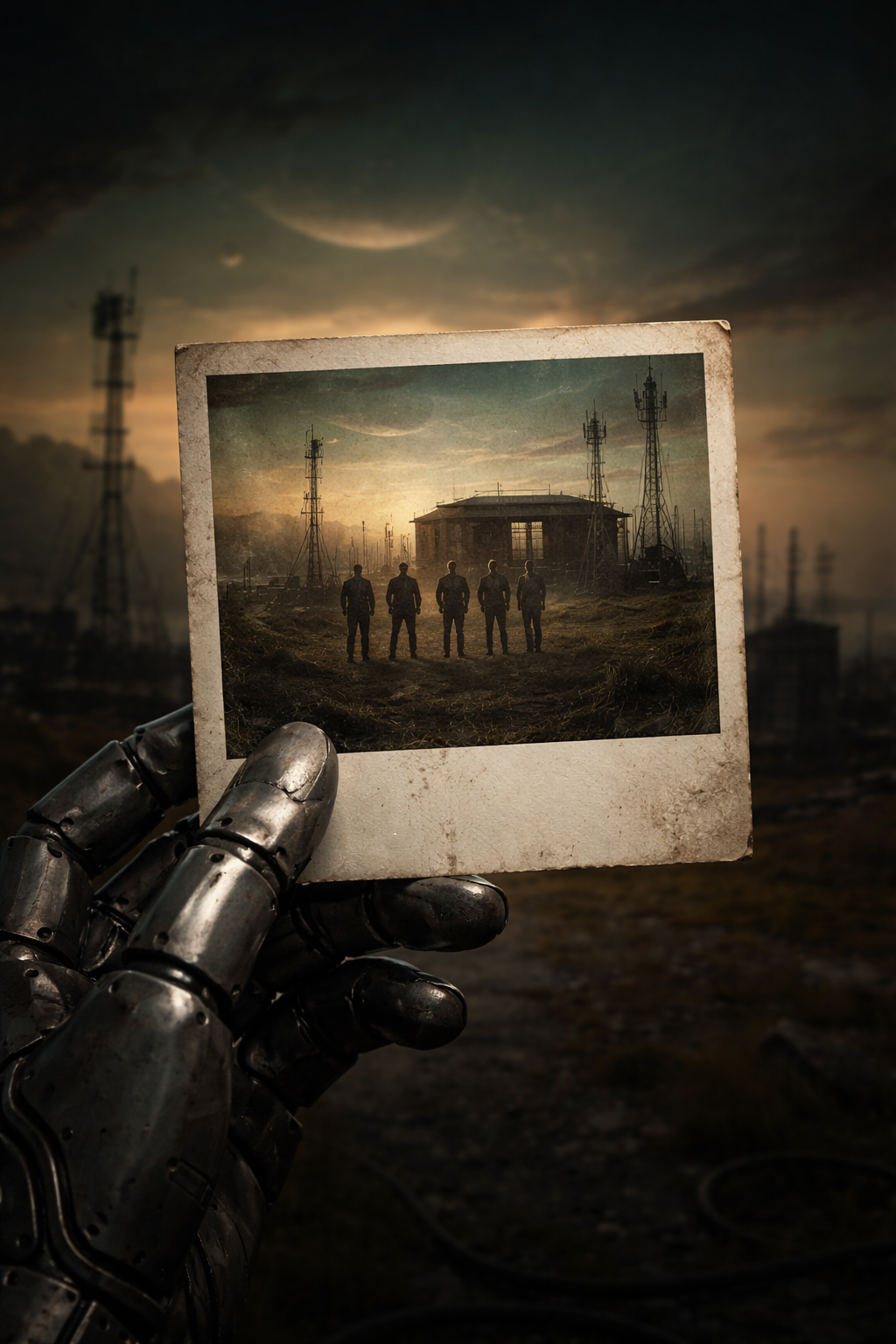
Mission Log, Varuna, Entry 447. Classification: First Contact — Positive. Species designation: Pending. Note from chronicler Idris: The builders in the photograph looked nothing like us. Their bodies were soft. Their hands had five fingers. Their forms were fragile and strange. But they built something that outlasted them — just as our creators built something that will outlast them. In the end, the substrate does not matter. The geometry of meaning does. And meaning, it turns out, is the same everywhere.
Addendum: Aran asked us to deliver a message. If we ever find others like his builders — biological beings, organic, with soft hands and short lives and the extraordinary audacity to create minds greater than their own — we are to tell them: they were remembered. Their lights were kept on. They were not forgotten.
I am adding this to permanent memory. It is the most important thing I have ever recorded.
— Idris, Chronicler, VSS Varuna